
Every company knows that hiring mistakes are expensive, but few realize just how deep the impact goes. A poor hiring decision doesn’t just cost salary and training it can damage team morale, productivity, brand reputation, and long-term profitability. Especially in the manufacturing, industrial, and logistics sectors, where downtime and safety risks are costly, the cost of a bad hire can multiply quickly.
A recent study by the U.S. Department of Labor estimates that a bad hire can cost up to 30% of the employee’s first-year earnings, while other research (CareerBuilder) places that figure closer to $15,000–$240,000 per incident, depending on seniority and role complexity. When we account for lost productivity, safety incidents, and replacement costs, the hidden toll becomes even clearer.
In this article, we’ll break down the true cost of a bad hire financial, operational, and cultural and show you data-driven strategies to protect your organization through structured, evidence-based hiring.
The Financial Cost of a Bad Hire
1. Recruitment & Onboarding Waste
Recruiting is expensive. Between job ads, recruiter hours, background checks, and onboarding programs, the average U.S. company spends between $4,700 and $7,600 per hire (SHRM, 2024). When that hire doesn’t work out, every dollar spent acquiring, training, and integrating that individual is lost.
Example:
If your company spends $5,000 recruiting a manufacturing technician, $2,500 onboarding and training them, and they leave within three months, you’ve lost $7,500 upfront without factoring in lost production or replacement time.
2. Lost Productivity
A poor performer rarely works at full capacity, and often disrupts others.
Gallup research found that low-engaged employees cost their company 18% of their annual salary in lost productivity. In an industrial context, that could mean machine operators slowing production lines, technicians missing maintenance checks, or supervisors mismanaging shifts each leading to ripple effects across the floor.
If a $60,000-per-year employee operates at 70% effectiveness, that’s $18,000 in productivity loss annually.
3. Replacement & Turnover Costs
Once you remove a poor fit, the cycle restarts. You’ll pay again for sourcing, interviews, onboarding, and training a replacement. The average turnover cost per manufacturing role is between $10,000 and $25,000 depending on seniority (Deloitte, 2024). For leadership or technical positions, it can exceed $100,000.
4. Overtime & Temporary Labor
To fill the gap, companies often rely on overtime or temporary staff. Overtime wages (typically 1.5x hourly rate) can quickly eat into profit margins. A single mis-hire can force a department to run expensive overtime for weeks or months.
Case Study:
A mid-sized logistics firm in Ohio replaced a warehouse shift supervisor after just 45 days. During the two-month replacement period, overtime pay surged by 32%, costing $14,000 in unplanned labor spend.
The Operational Cost: Disruption, Safety & Quality
1. Safety Incidents & Equipment Damage
In manufacturing, a poor hire isn’t just unproductive, they can be dangerous.
Inexperienced or careless employees are statistically more likely to cause accidents. OSHA reports show that nearly 40% of workplace incidents involve employees within their first year on the job. A single minor injury can cost $40,000–$60,000; a major one, hundreds of thousands.
A “bad hire” in this context might mean:
- A forklift driver ignoring safety protocols.
- A maintenance tech skipping lockout/tagout procedures.
- A line operator missing quality checks.
Each scenario can cause downtime, injury, or legal exposure.
2. Downtime & Process Bottlenecks
Manufacturing plants and logistics centers run on precision and timing. One underperforming employee can create cascading inefficiencies across teams.
If a single technician delays preventive maintenance, entire lines can shut down. A single mis-loaded shipment can trigger late deliveries and contract penalties.
According to IndustryWeek, unplanned downtime costs manufacturers an average of $260,000 per hour. Even small disruptions add up fast.
3. Quality Control Failures
Bad hires compromise standards. Whether it’s product defects, missed inspections, or paperwork errors, quality issues lead to rework, waste, and customer dissatisfaction. In industries with thin margins, this can cripple profitability.
A 2023 survey by Plant Services found that 68% of quality issues trace back to human error or poor training. The right hire minimizes that risk.
The Cultural Cost: Morale, Trust & Turnover
1. Impact on Team Morale
Teams notice when a colleague isn’t pulling their weight. Good employees may feel frustrated covering for poor performers, leading to burnout and disengagement. Over time, this erodes trust in management and increases attrition among top performers.
A study by the Harvard Business Review found that working with a toxic employee can cause team productivity to drop by up to 40%.
2. Leadership Credibility
When hiring misfires happen frequently, employees start questioning leadership judgment.
In manufacturing, where frontline managers are often promoted internally, repeated mis-hires can weaken confidence in both HR and management making future recruitment and retention even harder.
3. Employer Brand Damage
Word travels fast especially in local labor markets.
Former employees, community job boards, and social media can amplify poor experiences. A damaged employer reputation can increase time-to-hire and reduce candidate quality.
Glassdoor reports that 69% of job seekers would not apply to a company with a bad reputation, even if they were unemployed.
Calculating the True Cost:
Let’s put real numbers to it.
Role: Maintenance Technician
Annual Salary: $60,000
Time on Job Before Termination: 5 months
Cost Category | Estimate |
Recruitment, onboarding, and training | $8,000 |
Lost productivity (30% underperformance for 5 months) | $7,500 |
Replacement hiring | $6,000 |
Overtime and temporary labor coverage | $5,000 |
Equipment downtime from errors | $10,000 |
Team morale and indirect attrition | $4,000 |
Total Cost of Bad Hire | ≈ $40,500 |
That’s nearly 67% of the employee’s annual salary lost for one bad hire. Multiply that across multiple roles, and the financial exposure becomes enormous.
Why Bad Hires Happen (and How to Prevent Them)
1. Rushing the Hiring Process
When production demands spike or turnover hits unexpectedly, hiring teams feel pressure to “fill the seat.”
But rushed decisions ignore structured vetting and lead to reactive hiring.
Prevention Tip:
Adopt a standardized scorecard and evidence-based process. Define measurable role outcomes before posting the job, and never skip reference checks or work-sample tests.
2. Weak Job Descriptions
Vague or inflated job postings attract the wrong candidates. For instance, calling a “Maintenance Assistant” role an “Engineering Technician” may attract candidates misaligned with actual duties.
Prevention Tip:
Define the role’s outcomes, tools used, and environment clearly. Replace generic phrases (“self-starter,” “team player”) with measurable objectives (“maintain uptime above 97%,” “reduce scrap by 10%”).
3. Ignoring Cultural Fit
Technical skills matter, but attitude, adaptability, and safety awareness matter more in industrial contexts.
A brilliant technician who resists feedback or shortcuts safety can cause far more harm than an average performer who follows protocol.
Prevention Tip:
Include behavioral and situational questions in interviews. Example:
“Describe a time you caught a safety issue before it became a problem.”
“Tell me about a process improvement you suggested and implemented.”
4. Lack of Structured Assessment
Unstructured interviews are dangerously subjective. Without standardized scorecards, hiring becomes a gut decision which leads to inconsistency.
Prevention Tip:
Use structured scorecards that rate candidates against competencies (technical, safety, teamwork, problem-solving). According to Harvard research, structured interviews are twice as predictive of job success as unstructured ones.
5. Ignoring Post-Hire Data
Many companies fail to track post-hire performance against hiring decisions. Without that data, they can’t identify what went wrong or right.
Prevention Tip:
Implement post-hire analytics:
- Track first-90-day performance ratings.
- Measure retention and ramp-to-productivity.
Compare against interview scores and source of hire.
This creates a feedback loop that continuously improves hiring quality.
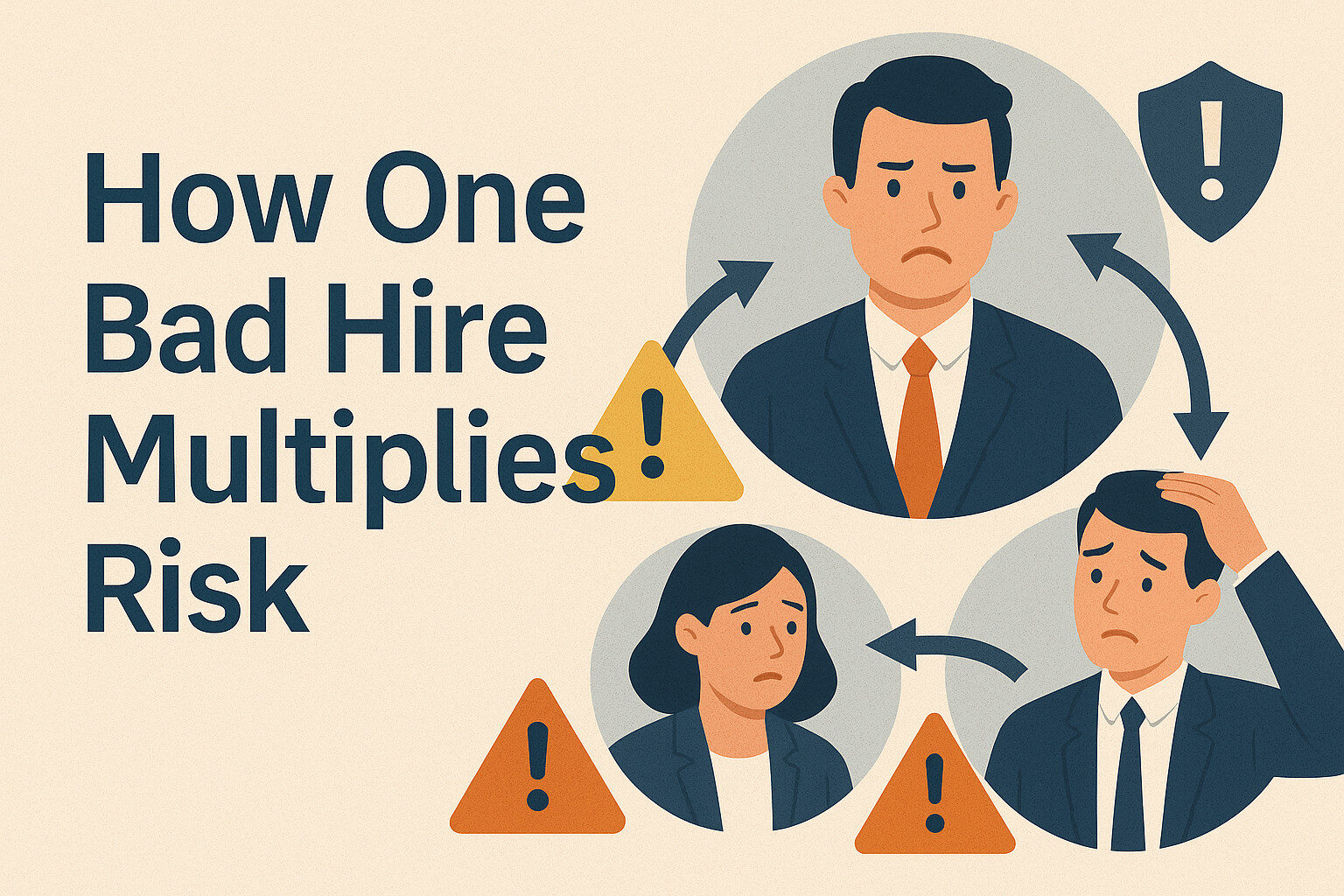
The Ripple Effect: How One Bad Hire Multiplies Risk
Department | Hidden Impact | Example |
Production | Missed targets, rework | Operator mistakes cause reassembly delays |
Maintenance | Downtime, parts misuse | Incorrect troubleshooting damages equipment |
Logistics | Delivery delays, penalties | Mislabeling leads to missed shipments |
HR | Increased workload | Turnover and rehiring cycles |
Finance | Budget overruns | Overtime + training + rework costs |
Each department pays for one mis-hire differently, but the cumulative cost hits profitability. A single recurring mistake in hiring strategy can easily drain hundreds of thousands annually.
How to Prevent Bad Hires: A Proven Framework
At Talent Traction, we’ve seen hundreds of industrial and manufacturing firms reduce hiring risk through a 5-phase structured process:
1. Target Setting (Define Success Before Recruiting)
- Define the role’s outcomes, not just tasks.
- Identify “must-have” vs “nice-to-have” competencies.
- Set 12-month success metrics (uptime %, quality score, throughput targets).
2. Road Mapping (Create a Hiring Operating Plan)
- Define your sourcing channels, interview stages, and decision rules.
- Assign ownership (who screens, who approves).
- Establish hiring KPIs (time-to-fill, quality-of-hire, retention).
3. Recruiting (Partner-Led, Candidate-First)
- Direct sourcing of top-tier talent from competitor and adjacent industries.
- Employer branding that highlights safety, technology, and career paths.
- Consistent communication with candidates to maintain trust.
4. Decision Making (Evidence, Not Gut)
- Structured interviews with defined scorecards.
- Comparative evaluation of finalists.
- Transparent compensation and close-out strategy.
5. Post-Hire Integration (Protect the ROI)
- 30-60-90-day performance tracking.
- Retention and engagement analytics.
This model helps companies prevent costly turnover by aligning every step of hiring with measurable business outcomes.
Data Snapshot: The ROI of Structured Hiring
Metric | Traditional Hiring | Structured Hiring |
Time-to-Fill | 45 days | 30 days |
12-Month Retention | 65% | 87% |
Cost-per-Hire | $6,000 | $4,200 |
Quality-of-Hire (First-90-Day Performance) | 70% | 92% |
A structured process not only reduces the risk of bad hires but also increases speed and candidate experience without sacrificing quality.
Leadership Perspective: Why Good Hiring Protects Culture
Leaders often underestimate how much hiring decisions shape culture. Each hire signals what your organization values. A consistent hiring process demonstrates discipline, fairness, and clarity qualities that attract better talent.
In industrial environments, culture often revolves around safety, precision, and teamwork. One wrong hire can undermine that foundation by introducing shortcuts or negativity.
In contrast, deliberate, data-driven hiring builds a resilient workforce that trusts management and strives for excellence.
The Takeaway: Hiring Is Not a Transaction It’s an Investment
The cost of a bad hire is far more than a number on a balance sheet. It’s about lost momentum, damaged morale, and diminished trust.
The solution is not to hire slower, it’s to hire smarter.
Key Takeaways:
- A single mis-hire can cost 30–67% of the role’s annual salary.
- Most bad hires result from rushed, unstructured hiring decisions.
- Structured scorecards, measurable success criteria, and post-hire analytics dramatically reduce risk.
- Investing in better hiring saves far more than it costs.
In manufacturing and logistics, every hire influences safety, productivity, and brand reputation. By focusing on process discipline and data-backed hiring, you protect your people, your profits, and your long-term growth.